
Do you remember the children’s song that went “Oh be careful little eyes what you see…”? I do. It was meant to remind us that every little decision feeds into a larger one. Those things that we think are small and insignificant or hide-able really are never hidden.
Recently — okay, it was months ago — I was researching fig trees. Something got into me where I just couldn’t think of anything but fig trees. Out of the thousands of types of fig trees, the one that stood out to me the most was the Strangler Fig. It’s a very unique tree.
If you live in America, you can find the Strangler Fig in the Florida Everglades. This tree is unusual: it sprouts from a seed that germinates from bird droppings on the branch of another tree, and sends its roots down to the ground from there. This makes the Strangler Fig what’s known as an epiphyte. An epiphyte is a plant that grows downward first, meaning it sprouts aerial roots and from there embeds in the soil — unlike most plants, which are planted in soil and then grow up.
But more than that, the seeds for this tree need a moist, dark, hidden place to grow. They start out of sight and then slowly extend their root system down to the ground. As the roots grow, they begin to wrap around the trunk of the host tree. This cuts off sunlight and restricts the growth of the host tree, eventually killing it off. As all plants do, the host tree will eventually wither away and decompose, leaving the Strangler Fig looking like a hollow tree.
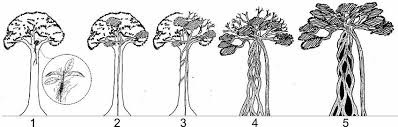
(From left to right: (1) the host tree stands healthy as the seedling sprouts in its branches; (2–3) the strangler’s roots descend and begin to wrap around the trunk; (4) the lattice tightens as the host starts to fail; (5) the host has decomposed completely, leaving the strangler standing hollow where the original tree once was.)
What’s truly interesting is that this tree bears fruit. It looks just like regular fig fruit, but if you look into it, the fruit is bland and dry. While it’s not toxic to humans, the only time it’s really ever been eaten has been during severe droughts.
So What?
I know what you’re thinking — this is cool and all, but what does this have to do with me, Jesus, or my spiritual life? Well, let me connect the dots for you.
I believe that the Strangler Fig is a call to remember. A call to remove things that are growing and shouldn’t be allowed.
We need to examine our fruit.
We’re called to be fruitful — but not just any fruit. Jesus said, “I am the vine, you are the branches. Whoever abides in me and I in him, he it is that bears much fruit, for apart from me you can do nothing” (John 15:5). Real fruit comes from staying connected to the source. The Strangler Fig bears fruit too — but it got there by slowly choking out its host instead of staying rooted in something life-giving. And that’s exactly how the fruit turns out: it looks the part on the branch, but it’s bland and dry on the inside. Sometimes we think we’re being fruitful when really we’re just producing something hollow.
So it’s worth stopping to examine what we’re actually growing. Not to shame ourselves, but to be honest. This is the prayer of Psalm 139:23–24: “Search me, O God, and know my heart; test me and know my anxious thoughts. See if there is any offensive way in me, and lead me in the way everlasting.” If you don’t know why you’re doing something, asking the One who knows us better than we know ourselves to show us what’s really there is the place to start.
Hypocrisy is not acceptable.
Throughout the Gospels (Matthew, Mark, Luke, and John) we see Jesus say that he wants real fruit, not just the appearance of it. He even goes so far as to curse a fig tree (like the kind we eat) because of its lack of fruit. The Strangler Fig, while it bears fruit, is a great example of hypocrisy. It appears as a tree, but inwardly it is barren. 2 Timothy 3 encourages the Church not to settle for outward religion, but to delight in Christ and seek him wholeheartedly, so that our example may lead others to him.
Small things grow big fast. Choose wisely.
We need to remember that small things grow big fast. Things that we allow because they are “pet sins” or “small” can become larger problems if we do not deal with them immediately. Proverbs 4:23 tells us to guard our hearts, for out of them is the wellspring of life. Galatians 5:9 talks about how a little yeast leavens the whole lump. While it was speaking of pride, I’m fairly certain it’s applicable here too.
Think of someone you know with a large dog. If they don’t train the dog properly when it’s small, it becomes unmanageable when it’s larger. I know people who have very large dogs — Dalmatians, Great Danes, Bernese Mountain Dogs. They allowed certain behaviors when the dogs were puppies because they were “cute” then. What they failed to see was that puppies who beg eventually learn they can table surf — eating right off the table. Those dogs become intolerable to be around as adults.
Here’s my point: big sins don’t start big. Bitterness doesn’t start as bitterness — it starts as unforgiveness, or an offense we never addressed. Choose what you allow to grow in your garden carefully.
In Closing
So what is parading around in your garden like a tree but isn’t? Is there someone you need to forgive? Did someone offend you, and you’ve just been holding onto it? Maybe it’s something you do in the solitude of your room when no one else is around. Whatever it is, I encourage you to do the following:
- Pray. Take it all to Jesus and talk to him about it. Tell him everything that happened — how it hurt you and made you feel. Don’t tidy it up first. Jehovah Rapha, the great healer, is always available to heal you, and bringing it honestly to him is the first step to getting that healing.
- Tell someone you trust. This is how you begin to build accountability — not to do it again, and to break the hold it has over you. There’s something about saying a thing out loud to another person that takes away its power to hide. Remember, the first thing David did when he faced Goliath wasn’t to sling the stone. It was to call the lie a lie.
- Start speaking out against it. Sometimes that’s as simple as saying, “I forgive you, [Name].” Say it as many times as you need to. Forgiveness can be instant, but it can also take time — no two people are the same, so do what you need to do, as often as you need to do it. You’re not failing if it takes more than once.
If you’ve read all this and you don’t know what Stranglers are in your garden, ask God to reveal them. I’ve found that he knows me better than I know me, so asking him opens the door for him to go to work.
I’m praying for you all, always,
Hannah

 Whispers of Christ